Submitted by Mahina Hanakahi-Gibson, Lennie Nahulu and Kūlia Vares
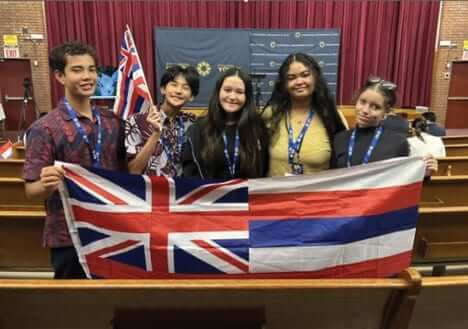
On a global stage, Hawaiian voices are amplified, providing unique Indigenous worldviews, perspectives and values. Five sophomore members of Kamehameha Schools Kapālama, Kaʻāmauloa Leadership Pathway were in Manhattan in September attending events at the UN General Assembly and New York Climate Week. In parallel, they were also Hawaiʻi delegates to a youth conference convened by the International Organization of Youth.
For Mahina Hanakahi-Gibson, attending the youth conference was an empowering experience: “I loved seeing youth from around the world who were actively succeeding in changing the world around them. It was amazing to see how many young people sought out opportunities and even made their own, like the many who made nonprofits. It was also cool to see adults coming to listen to presentations just to hear youth voices and ideas.”
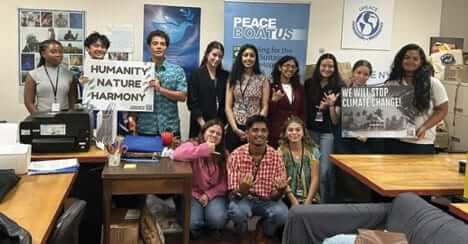
For Lennie Nahulu, it brought a new perspective to what she hopes to do in the future. “Coming into this I thought I wanted to go into politics and governmental roles. I wasn’t sure what purpose I would have, but I knew I wanted to serve my lāhui. Going to New York helped me experience different cultures, perspectives, and knowledge. Stories of people who faced challenges and found solutions to solve them.
“What stood out the most was the fact that these people weren’t much older than me and had already achieved so much. I saw them as the next chapter of my life. So, coming out of this experience I came to the conclusion that I need to start now; I need to make change now. My career focus stayed the same, but I found that my love for the land can be instilled into politics, best seen for me under conservation policy.”
For Kūlia Vares, the trip was transformational. “Coming from a small community in Heʻeia, it was hard for me to see the impact our ideologies can have. Waking up, you feel the Mololani breeze, you step outside to breathtaking mountains, valleys and hillsides without questioning the value this has to others. It was hard for me to imagine a world without island culture, without lush forest and clear skies.
“New York, a polar opposite from Hawaiʻi, opened my eyes to the value and impact of Hawaiʻi from an outside perspective. The power that Hawaiian youth voices have is astonishing.”
On the fourth day, the students met with the Nature Conservancy as part of an event showcasing the newly implemented reef insurance in Hawaiʻi. They were there to provide cultural perspectives on something critical to the lives of many in Hawaiʻi.
But Vares took away much more than that. “This showed me that western concepts of stewardship and protection could be successful without comprising traditional values of aloha ʻāina. This new concept has transformed my way of thinking for good.”
The next day, Nahulu was featured on a panel hosted by Blue Planet Alliance emphasizing the idea of traditional values and the importance of education, reflecting values of aliʻi of the kingdom era.
At the end, Vares chanted part of the Kumulipo, explaining its significance to Hawaiian perspectives and how the entire belief system of the Hawaiians reflects ʻāina and the ways that it ties into climate change. “This taught me that our stories aren’t something of the past nor do they only relate to Hawaiʻi; our ʻike kūpuna can set the blueprint for this modern world.”
As they stepped off the long flight back from New York the students were in total agreement with manaʻo shared by Vares: “Overall, that week was of so much growth that you simply can’t get through classroom style teaching. The saying of our kūpuna, ʻMa ka hana ka ʻike’ (one learns by doing), couldn’t be more true.”
They also feel strongly that it needs to be repeated. Hanakahi-Gibson put it best: “Those following us should have this opportunity because it silences doubt. It tells them ʻyou can.’ It shows them how. I went into that conference expecting a group of strongly voiced adults and some kids but left knowing there are hundreds of youth from around the world who want to make change like us. But their speeches and solutions didn’t involve as much of their culture.
“This showed me how unique Hawaiʻi is and how special our culture and values are, from the reciprocal and familial relationship we have with the land to our understanding as an island people that everything is connected. The planet needs culture and ancestral intelligence to survive, that is what Hawaiʻi has to offer.”
Mahina Hanakahi-Gibson, Lennie Nahulu and Kūlia Vares are sophomores from the Ke Kula ʻo Kamehameha Kapālama Kaʻāmauloa Leadership Pathway. The program nurtures a new generation of ʻōiwi youth by blending traditional Indigenous knowledge with global diplomacy to create leaders confident and grounded in who they are, who know the issues, and who can contribute to shaping policy locally, nationally and globally. Travel was made possible by the generous support of the Nakupuna Foundation.