The world is changing in profound ways. Scientists are creating synthetic DNA. Engineers are launching us back to the moon. And we have created AI programs that write and code far faster and better than the average person.
All this and more is reshaping human civilization in ways that are breaking important assumptions we have held about the world for generations.
This is a moment in human history when more people than ever before have the tools and inspiration to change the world; to pursue their own visions for how things could be different in the future.
Even a quick doom scroll through your social media feed will confirm that lots of people out there, for both good and bad reasons, are actively pursuing change and reshaping the trajectory of human history.
Vision is Lacking
Amidst all this turbulent change sits Hawaiʻi, a place – for better or worse – that has traditionally been more focused on its past than its future.
And at a time when it is more critical than ever for communities to think critically about the expanding range of possibilities the future represents, Hawaiʻi’s people share no truly compelling vision for that future. Not even a common language to talk about what those possibilities might look like.
And the unfortunate truth is that, today, with so many others busily pursuing change in the world, if we are not pursuing our own vision, then we will end up living in someone else’s future. Again.
Real vision in this sense is not simply an artful description of values or hopes (though those are central), it is a description of the future you want; one that acknowledges the changing world around you and is informed by the true range of what is possible tomorrow.
And that requires frank conversations about the present and a broad understanding about how the future could unfold.
In short, vision requires foresight.
Rewriting History to Rethink the Future
Thinking about the future comes naturally to us. We do it every day, all day long.
Thinking critically about the future, however, is hard. It is especially hard in times of great volatility and growing uncertainty. Times like today. There is simply so much change going on, in so many places around the world, it can be overwhelming.
One way to ease into thinking critically about the future is to start by thinking critically about the past. This is easier because, while the future does not yet exist, everyone knows at least a little history.
However, in thinking critically, we should do more than read history – we should rewrite it. Historians call the exercise a “counterfactual,” futurists, like me, call them “alternate histories.”
So, before we talk about a vision for Hawaiʻi, let us consider what things might look like today had the future unfolded a little differently.
A History Without the Overthrow
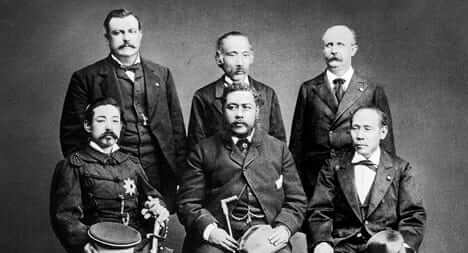
Without the overthrow, modern Hawaiʻi would be a parliamentary constitutional monarchy, with a prime minister and an elected parliament.
It would have a decades-long history as a diplomatic and cultural hub in the middle of the Pacific, it would have deeper and lasting economic and political ties to countries like the United Kingdom and Japan, and it would boast a modestly sized and modestly diversified economy with some notable achievements related to things like education, agritech, and astronomy. And it would, of course, feature a very different socio-economic landscape.
Why these things and not others? Because Hawaiʻi would be a longtime security-based treaty ally with the United States, whose security concerns and economic importance to the kingdom would have played an ongoing role in Hawaiʻi’s affairs after the failed coup of 1893.
With America a rising power in the late 19th century, and with Hawaiʻi’s economy built around American markets, Hawaiʻi would have not have able to simply walk away or turn to a competing world power for a credible security guarantee in the middle of the Pacific.
Pragmatism would have balanced idealism.
The monarchy – and increasingly, the parliament and government – would have prioritized diversifying the economy and its export markets as much as possible, along with building strong relationships with other countries. And America’s involvement in overseas conflicts, from the Spanish-American War to WWI to WWII, would have only increased Hawaiʻi’s geostrategic value, meaning the U.S. would never want to leave – but also providing the slowly growing leverage to negotiate for more in return for an American military presence.
As an intentional diplomatic and economic hub between East, West, and the Pacific, Hawaiʻi would cultivate its relationships and cultural competencies as an enduring soft power.
A convener and hub, both sovereign and covered by America’s security umbrella, it would be able to criticize American policy even as it was forced to abandon strict neutrality repeatedly across the 20th Century.
And with its diverse population and independent political stance, Hawaiʻi would find itself perpetually caught between conflicting world powers: Japan and the U.S.; Russia and the U.S.; and most recently, China and the U.S.
And … Hawaiʻi’s business class would not only look different, it would have over a century of kingdom-based trade and relationships across the Pacific and the world. Its educational system would be structured differently, with quite contrasting outcomes and connected to respected international programs.
Its political parties would, of course, be different and its politics unique – though its debates over land use, economic policy, taxes, power, and foreign policy would at least be recognizable to us. And perhaps most importantly, many of the most divisive and painful societal issues that have defined local society for so long would simply be absent.
But unfortunately, social media and smart phones would create the same divisive, isolated, and polarizing issues that it did for everyone else.
Thinking Critically, and Expansively,
About Tomorrow
So, what does an alternate history like this tell us? What lessons and reminders should we keep as we think about our own futures?
- It reminds us that a lot of very specific things had to happen over the past 133 years for Hawaiʻi to turn out exactly as we know it today; all along the way there were myriad different paths that events could have followed and many possible futures for Hawaiʻi. We just happened to live through one of them.
- Small changes at pivotal moments in history can dramatically change the course of the future. We knew that already, and it bears repeating, especially because with today’s tools and connectivity, that virtually everyone has a real possibility to create strategic effects in the world. Including you and I.
- Since the modern age, global events and world transitions have always strongly reshaped Hawaiʻi’s path. Failing to consider how the world beyond Hawaiʻi may change over the next decade or two – and how that will impact Hawaiʻi – creates a major blind spot in our thinking.
- Economics is pivotal and history shows us that economics and politics are inseparable (most especially in Hawaiʻi). Serious discussions of Hawaiʻi’s future cannot ignore the practical realities of either.
- A description of history is considered “rich” when it traces out how all these things – politics, economics, social issues, technological change, and environmental change – interact to create the twisting, turning, and unforeseen opportunities and challenges that people encountered in the past. These are the interesting and insightful stories to read. It is only logical that our discussions about the future should be just as rich.
So, as we try to think about Hawaiʻi’s future during this particularly turbulent, rule-resetting moment, we can perhaps boil these lessons down to a couple of key ideas to help us.
First, there are many possible futures for Hawaiʻi – not one. Next, try to create a “rich” picture of how the world is changing. Finally, in thinking critically about the future, understand that you are not trying to capture everything out there – that is simply not possible.
Rather, like our alternative history above, you are simply trying to weave together more threads in more interesting patterns to understand more of what is may be possible as the world changes around us.