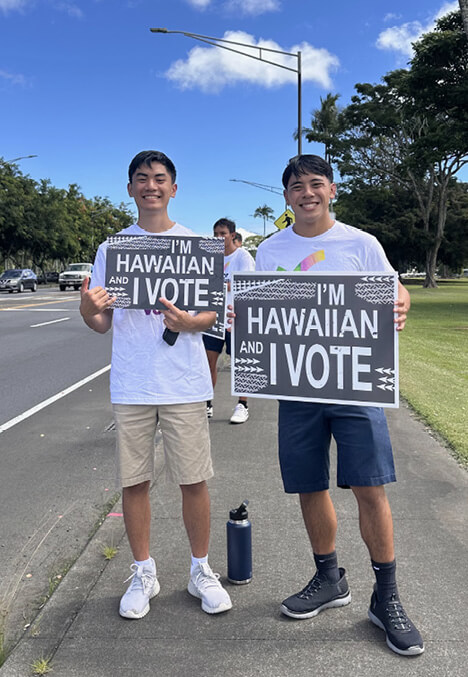
Kamahaʻo Halemanu has been interested in civic engagement since high school. During his senior year at Kamehameha Schools Keaʻau he spearheaded Hawaiʻi Island’s participation in “Our Kaiāulu Votes,” a youth voting initiative during the 2024 election cycle.
This election cycle, Halemanu is a second-year student at Amherst College in Massachusetts but he still wanted to do something that would boost voter turnout in Hawaiʻi for the 2026 election.
So he and his Kamehameha classmate, Cajohn Hano Mar, who is currently enrolled at Oregon State University, decided to collaborate on an educational website promoting civic engagement as being something very Hawaiian.
“We decided to create an ArcGIS StoryMap that talks about the history of Kānaka Maoli voting, as well as its connection to Ke Aupuni o Hawaiʻi, the Hawaiian Kingdom,” Halemanu said.
The website, Kuleana ʻŌiwi, is an abridged timeline of more than 100 years of political power in Hawaiʻi starting with Kamehameha’s unification of Hawaiʻi Island in 1781 up to the U.S. annexation of Hawaiʻi in 1898.
The non-partisan, interactive website is designed to remind the lāhui that the Hawaiian people have a long tradition of civic engagement, collective responsibility, and self-governance and to encourage participation in the political process today – specifically voting in the 2026 elections.
Kaulana Nā Pua, the iconic patriotic song about Hawaiian resistance against the 1893 overthrow of the monarchy, is featured on the website’s landing page and other songs about Hawaiian national pride are featured all throughout the site.
“It’s a reminder that no matter where we stand politically, Hawaiʻi’s history is always rooted in the Kingdom of Hawaiʻi,” Halemanu explained.
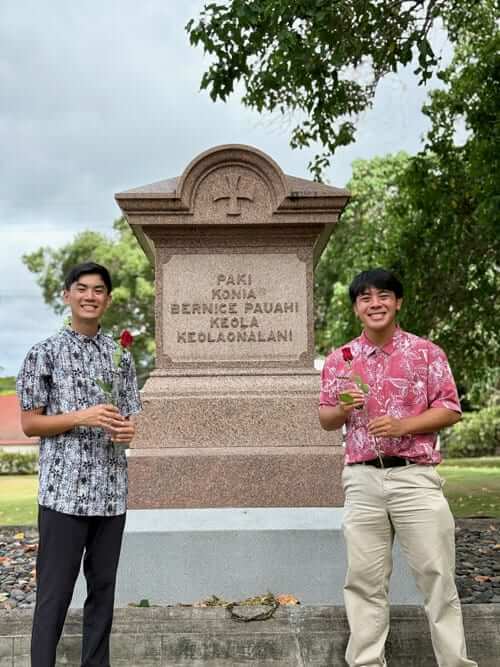
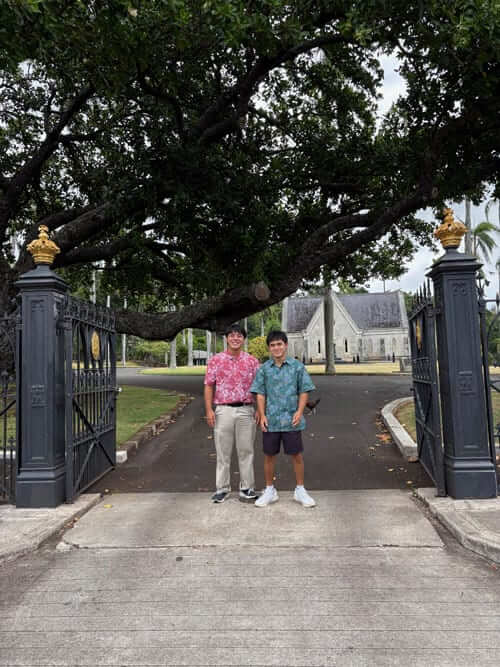
The project is supported by a grant from the Center for Native American Youth (CNAY). Mar and Halemanu traveled to Oʻahu for research and to visit historical sites like Bishop Museum, Mauna ʻAla and ʻIolani Palace.
The site has been shared by CNAY, Kanaeokana, ʻAwili Hawaiʻi (a youth-powered nonprofit in Hilo), and on other sites and social media platforms.
Kuleana ʻŌiwi began as an informational resource for the community – a way for Halemanu and Mar to kākoʻo the community despite being away at college. But after noting the low voter turnout in last August’s Primary Election, Halemanu renewed his involvement in Our Kaiāulu Votes (OKV) as the initiative’s “civics attaché.”
In this capacity, Halemanu serves as a role model and resource for the 17 youth on OKV’s ʻŌpio Steering Committee who are working on strategies to improve voter turnout for the upcoming General Election in November.
Hawaiʻi’s Primary Election voter turn out hit an all time low this year. The total number of registered voters across the state is 850,000 but only about one-third of them voted.
“That means a third of the people who live in Hawaiʻi are controlling who will be in these places of power,” he said. “A third of the people are controlling the protection of our wai and our ʻāina.”
Many of the legislative and county races were determined before the Primary Election. There were 24 incumbent candidates (5 Senate, 13 House and 6 county seats) with no competition at all. Voters didn’t even have a choice for those seats.
Additionally, the Primary Election confirmed 10 candidates as winning their seats because the challengers were all in the same political party. So, the races for the candidates who won in the Primary are done. Voters will not have a chance to vote on those seats in the General Election.
Many people don’t pay a lot of attention to Primary Elections because the General is where final decisions are made. But Primary results determine who even makes it to the General.
The harsh reality of not voting is that ongoing issues plaguing our community such as water rights, affordable housing, the lack of economic diversification, sustainability and outmigration of young Native Hawaiians and other kamaʻāina (brain drain) continue unchanged despite years of “discussions.”
ʻĀina protection, housing policies, water rights, livable wages, development, and natural resource management are all political issues. Caring and paying attention to the decisions being made for and about our community – and who benefits (or is harmed) by them – is critical because the laws that politicians make affect us all, whether or not you vote.
Halemanu argued that without taking action today, the percentage of Hawaiians living in Hawaiʻi will continue to decline.
“We, the people of Hawaiʻi, have a civic duty to think about how can we best protect our land, resources and our people,” he said passionately. “And voting is one of the best things that we can do to elect people who care about Hawaiʻi into positions of power.”
Back in high school, Halemanu had one teacher he thought would be opposed to voting but found out otherwise when he was coordinating youth voting rallies.
“He was very kūʻē and his pedagogy was based in international law and politics,” he said. “He brought me up in front of the whole class and said ʻCome on, let’s do it. We gotta vote! You guys gotta get political!’”
Halemanu shared that his perspectives on current issues, his political advocacy in college, his support for Kamehameha Schools regarding the recent lawsuit, and his work to coordinate community civic engagement all connects back to what he learned from this particular teacher.
“That foundation that he gave me in Hawaiian Kingdom law and history, really informs my decisions.”
Knowing this history has also helped him to understand his kuleana to his community as a Hawaiian.
“Hawaiʻi had one of the highest literacy rates in the world,” he said. “Hawaiians debated through the newspapers, and when Kalākaua won the election against Queen Emma in 1874, there was a riot! That’s how much they were into the politics of it,” Halemanu said.
The website is not just for Hawaiʻi but for audiences worldwide. He wants people globally to understand Hawaiʻi’s history of sovereign governance, international diplomacy, and law – and to see the real struggles of Native Hawaiians today instead of just the tourist-friendly images of Hawaiʻi and Hawaiians that most people see.
Voting and being makaʻala (alert) to the decisions being made about our community – and holding those in power accountable by speaking out about what is right – is one way to effect change.
Halemanu added, “Going back to what Haunani Kay Trask said at ʻIolani Palace [in 1993] – besides saying ʻwe are not American,’ she also said ʻHawaiians need to learn to be political.’”
Visit Kuleana ʻŌiwi at: bit.ly/kuleanaoiwi