By Lōpaka and Tanya Kapanui
There are many versions of the legend of Kaululāʻau, the trickster and troublemaker whose father sent him to live on the ghost-inhabited island of Lānaʻi. A personal favorite is “The Sacred Spear-Point,” a short story by King David Kalākaua, which appears in his collection of moʻolelo, The Legends and Myths of Hawaii.
The king’s beautiful, ornate language was intimidating, and at my young age, I needed a dictionary to understand words I had never seen before. But I was enthralled, and a second read-through let me fully enjoy the king’s writings. The story of Kaululāʻau captured my imagination.
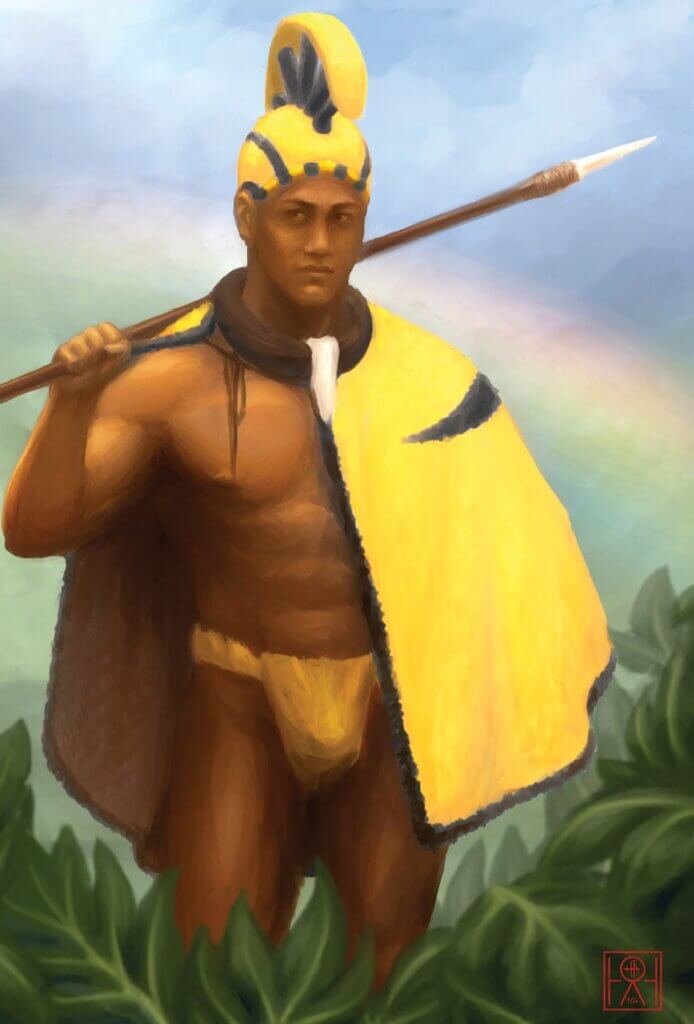
Here was a boy who loved playing tricks on people, but a day came when Kaululāʻau went too far.
I’m sure we all know a prankster from our youth, or perhaps we were the kolohe ones. This writer’s parents and brothers might have pointed a finger at him given the question, but I’m sure my shenanigans were not nearly as traumatizing as those of the son of Kakaʻalaneo.
In any case, Kaululāʻau was the antihero my youthful, kolohe heart needed.
Other versions of the story that I discovered later also shaped my impression of Kaululāʻau. Accounts retold by W. N. Pualewa, Emma Kaʻilipuolono Nakuina, Abraham Fornander, Martha Beckwith, and Mary Kawena Pukui offered new details, different language, and sometimes an alternate perspective.
Comparing the tales shared by these storytellers has given me a deeper appreciation for our Hawaiian moʻolelo. Every version changes things a bit, but the overall arc of the story is the same. What follows is my own respectful retelling, drawn from these sources and from the tradition that has kept the legend of Kaululāʻau alive.
The Legend of Kaululāʻau
In the early 15th century, Hawaiʻi was not yet a unified kingdom, and each island had its own rulers. On Maui, the brothers Kakaʻe and Kakaʻalaneo ruled over the island together from Lele, the ancient name of Lahaina.
As the eldest son, Kakaʻe was the legitimate heir, but it is said that an accident in his youth impaired his mental faculties, so Kakaʻalaneo acted as a joint ruler and virtual king in his brother’s stead.
Kakaʻalaneo was the father of Kaululāʻau. He is remembered as a well-respected ruler concerned with the prosperity of his people. Tradition credits him with planting the ʻulu groves that would become one of the defining features of the land as expressed in the name, “Ka Malu ʻUlu o Lele” (the shaded breadfruit grove of Lele).
ʻUlu was highly regarded and considered extremely valuable. To plant one ʻulu tree was a meritorious act, and to plant a grove was an act worthy of the gods. Conversely, destroying one tree merited death, and destroying many was a declaration of war.
Kanikaniaula was a woman of exceptionally high aliʻi status, descended from the line of Kamauaua of Molokaʻi. Despite her status, she lived quietly with a husband of lesser rank, concealing her lineage.
After her death, her spirit encountered ʻEleʻio, the kahu of Kakaʻalaneo and legendary kukini (an elite foot runner and messenger) who restored her to life. Among her possessions was an ahuʻula, a magnificent feather cloak that was unlike anything ʻEleʻio had ever seen. This was the first of its kind in Hawaiʻi.
When ʻEleʻio presented Kanikaniaula and her ahuʻula to Kakaʻalaneo, he was so impressed with her beauty and grace that he made her his queen. She became the mother of Kaululāʻau in a story that is remarkable even before her famous son enters it.
Kakaʻe had a son named Kahekili. Today, he is often referred to as Kahekili I, as this was three hundred years before the time of Kahekilinuiʻahumanu, also known as Kahekili II, who ruled over Maui and Oʻahu during the time of Kamehameha.
Though the cousins Kahekili and Kaululāʻau were about the same age, they could not have been more different. They grew up together, learned from the same teachers, and were taught the same moʻokūʻauhau, but their personalities were quite opposite from each other.
As aliʻi piʻo, the high-ranking chief and the rightful heir to his father’s rule, Kahekili was well aware of his status. A kaula (prophet) foretold that a descendant bearing his name would be Maui’s last independent king. This sobering thought left Kahekili to often worry about the future. He was known for his intelligence and kind-heartedness, and he earned the respect of his people.
Unlike his sacred cousin, Kaululāʻau did not have the strict responsibilities of royal succession.
While Kahekili was wrapped in protocol and ceremony, Kaululāʻau focused on enjoying himself with shenanigans, music, and ʻawa. He was smart, handsome, and blessed with supernatural strength, but was also very kolohe. He was a recklessly wild trickster who would keep the village in an uproar for weeks at a time with feasting and hula.
Kaululāʻau played pranks on members of the aliʻi class, making him popular with the makaʻāinana, the commoners. His list of hijinks included setting waʻa (canoes) adrift, opening the gates of loko iʻa (fishponds), and painting puaʻa (pigs) black to trick kāhuna in their sacrificial ceremonies.
In those days, hearing the call of the ʻalae ʻula, or Hawaiian moorhen, at night was considered a bad omen. This is the famous bird that held the secret of fire until Māui forced him to reveal it.
Because of its ties to the spirit world and the gods, the ʻalae ʻula was viewed with great spiritual reverence and caution. Hearing its sudden cry at night was interpreted as a warning of impending misfortune, sickness, or death in the household.
Kaululāʻau created an instrument that could imitate the call of the ʻalae ʻula, and played it outside people’s homes, causing fear and distress. He also had a talent for making others believe that they were being prayed to death.
Kalākaua says that Kaululāʻau committed an unforgivable offense of disrespecting Kakaʻe, his father’s sacred brother, causing his exile to Lānaʻi. However, Pualewa explains it differently.
Kaululāʻau enjoyed playing a game called keʻa pua, in which he would throw arrows or darts made from the dried flower stalks or tassels of kō (sugar cane). When one landed in an ʻulu tree, he would shake the tree until the dart fell. But if the dart remained stuck, Kaululāʻau would simply pull the tree up by its roots and toss it aside, leaving it to die.
At first, no one thought much about what he was doing, until they realized he kept doing it. Shoot the dart; the dart gets stuck; shake the ʻulu tree; it doesn’t work; pull up the whole tree. In his careless, kolohe way Kaululāʻau continued uprooting the trees until an entire ʻulu grove lay barren.
The people of Lele were incensed, but the kaula, Kūkamolimoliaola, warned against beating or killing Kaululāʻau because the land would be blessed by his deeds. So, as punishment in lieu of death, Kakaʻalaneo said it would be better to send his son to live on Lānaʻi since he is kolohe, just like the spirits on that island. If the spirits kill Kaululāʻau, then so be it. But if he destroys all the spirits, then his kolohe nature will have proven useful.
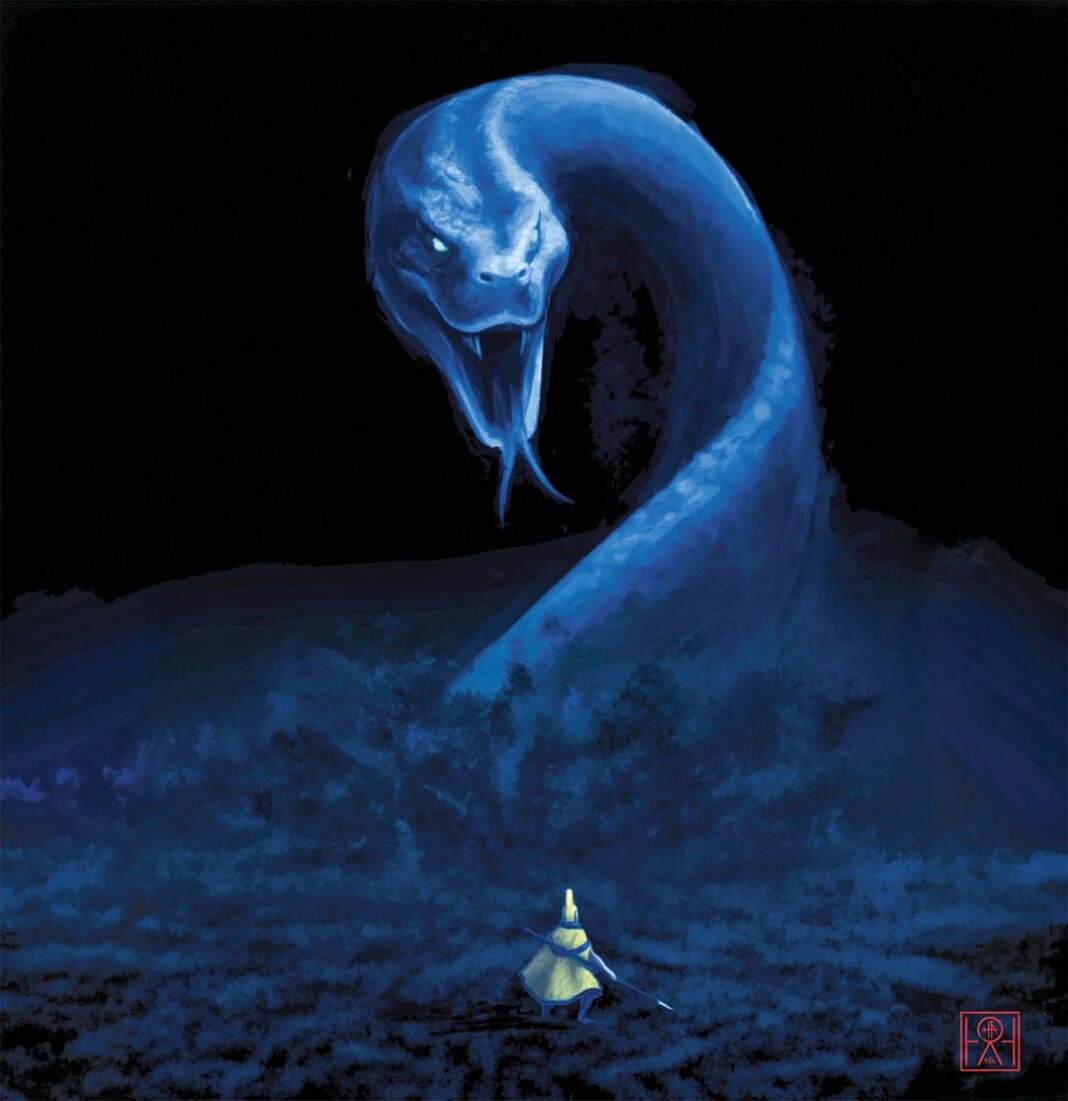
At that time, Lānaʻi was infested with ʻuhane ʻino and akua ʻai kanaka, evil spirits and man-eating ghosts, including the huge moʻo, Moʻoaleo. They killed animals, destroyed crops, uprooted coconut trees, wrecked the walls of fishponds, and made life quite unbearable for the human inhabitants of the island.
Although kāhuna tried to quiet these spirits, their efforts were in vain. If the kāhuna rid one place of destructive spirits, those kolohe beings would just wreak havoc in another.
Knowing what lay ahead of him, the kaula and kāhuna instructed Kaululāʻau in many charms, spells, prayers, and incantations to help him resist the spirits and monsters. The kahuna nui, Waolani, gave the young aliʻi an ivory spearpoint that had been dipped in the waters of Pō, the realm of darkness and mystery.
The spearpoint was imbued with powers greater than any akua he might encounter. If he drew a line with the point, nothing will be able to pass the mark. If he set it upon a spear and threw it, it would reach its target no matter how far away.
Proving this point, Kaululāʻau mounted the ivory atop a long spear and attacked the akua on Lānaʻi shortly after he arrived. He spent his days hunting down and defeating the spirits that terrorized the island’s people, traveling across Lānaʻi confronting one being after another.
Among the many akua Kaululāʻau encountered, Moʻoaleo proved to be one of his most formidable opponents. Beating this creature required more than simple strength, for the great moʻo avoided Kaululāʻau and remained beyond the influence of the magical spearpoint.
Realizing the moʻo traveled underground, Kaululāʻau used the tip of his spear to draw a circle on the ground, just above the space where the moʻo was burrowing. No matter how deep Moʻoaleo dug, it could not pass the boundary of the circle above him; it could only go deeper. But deeper did not mean escape, for soon the moʻo encountered a lake of fire and was forced to return to the surface. After the moʻo promised to leave Lānaʻi forever, Kaululāʻau erased the line in the dirt and allowed Moʻoaleo to escape to the sea, never to return to the island.
Kaululāʻau did not defeat every enemy through force. His quick thinking and kolohe nature became his greatest weapons on Lānaʻi. In one instance, when the akua asked him where he would sleep, he gave them a false answer and said he would sleep in the thorny puakala patch. When they rushed in to capture him, they were caught on the sharp branches where Kaululāʻau was able to kill them.
In one of his cleverer schemes, Kaululāʻau gathered several akua at Lānaʻihale and waited until they had settled down to sleep. Moving quietly among them, he used kepau, a sticky substance made of ʻulu sap, to seal their eyes shut. With their sight taken from them, they could neither see his next move nor escape. Kaululāʻau then set the hale ablaze, destroying the akua inside and freeing another part of Lānaʻi from their terror.
At Kaunolū, he confronted another gathering of akua. Although he destroyed these monsters, he spared Kānemakua, the spirit who cared for the fish and was destined to become the akua of the fishermen.
Later, he encountered an akua named Kuahulua, described as having a large, protruding belly. Kaululāʻau killed him before continuing toward Mānele.
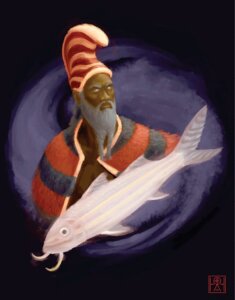
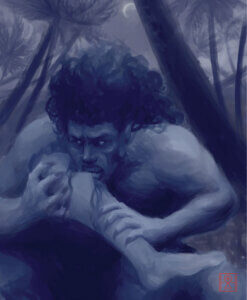
Eventually, only Pahulu, the god of nightmares and ruler over the ʻuhane ʻino and akua ʻai kanaka of Lānaʻi, remained. Wise to his trickery, Pahulu was not an easy target for Kaululāʻau.
However, on one moonlit night, Kaululāʻau hid in a tree that hung over a spring. As he sat there, waiting for Pahulu to come for a drink, he held a large stone in his arms. Finally, when the akua bent over the water, Kaululāʻau moved the leaves aside and made his reflection appear in the pool below. The image made Pahulu think Kaululāʻau was in the spring, and he dove into the water to seize him. Kaululāʻau dropped from the tree and struck him with the stone.
In one version of this story, Pahulu is killed instantly. But in another, after Kaululāʻau hit Pahulu with the stone, his spirit leaped into the sea and entered a weke pahulu (Upeneus taeniopterus). It is said that eating the brains of this fish causes one to be possessed by Pahulu’s spirit, producing terrifying nightmares.
It took more than a year to rid the island of the malicious spirits. Kaululāʻau was so successful in making life easier for the people who lived there that they gave thanks with offerings of the best goods from both land and sea. When Kakaʻalaneo heard about his son’s triumph, he sent word to Kaululāʻau, offering forgiveness and telling him to come home.
But Kaululāʻau found life on Lānaʻi to be enjoyable. He had comfort and companionship and could think of nothing on Maui that he could not get on Lānaʻi. He thanked his father and announced that he would return to Maui sometime in the future, after visiting the other islands.
The Land Remembers
The legend of Kaululāʻau doesn’t end with the ghosts he defeated. In a way, the landscape of Lānaʻi preserves the names of the places and beings associated with his exploits.
Lānaʻihale, or House of Lānaʻi, is the island’s highest peak where Kaululāʻau outwitted a group of akua and then defeated them by setting the hale on fire while they were trapped inside.
Kaunolū and Kuahulua still carry the names of places and supernatural beings encountered along his journey.
Even Pahulu, the formidable king of ghosts, lives on in the name Pahulu Well, which is recorded in traditional place-name records of Lānaʻi.
This is how the story of a kolohe boy who was sent to a haunted island became inseparable from the island itself.
Lānaʻi was no longer just the place where Kaululāʻau was banished; it became “Lānaʻi a Kaululāʻau,” the island forever associated with the young aliʻi who rid the place of its ghosts.
A Land of New Ghosts
Now, remember that the story of Kaululāʻau took place in the 15th century, and while the youthful Kaululāʻau worked hard to rid the island of the ancient akua ʻai kanaka, there has been plenty of time for new ghosts to appear. Every place has its ghost stories, and Lānaʻi is no exception.
In the center of the island lies Lānaʻi City. Our friend James described the small town he grew up in as having little for teenagers to do. Before cell phones, they would hang out at night, looking for excitement, an activity that almost always seemed to evolve into ghost hunting. The kids never had to search for long, as someone always had a thrilling story.
Children on Lānaʻi still share stories about a little girl whose spirit is stuck at the Social Hall. Hunters tell stories about being followed by a ghostly woman in white, seemingly in the middle of nowhere. We’ve even heard tales of the huakaʻi pō, who still march along their ancient paths.
James explains that a night marcher’s trail comes down from the mountain in the east toward the Social Hall. The Hawaiian Pineapple Company originally built the large bungalow-style home as the plantation manager’s residence. The old house became a community center in the mid-1930s and was simply called the “Social Hall.” Those who lived near the Social Hall often heard the pahu (drums) of the phantom army.
From the Social Hall, the trail makes its way toward the old Hotel Lānaʻi, through Dole Park and the nearby neighborhood, and finally makes its way toward The Lodge and the cemetery beyond. It was at this cemetery that James’ friend got mysterious scratches on her back while ghost hunting one night.
I met a man who grew up on Lānaʻi through our Buddhist organization, and he eventually became my mentor. I affectionately call him “Dad,” although we are not related.
He used to live a block away from Dole Park and said that the huakaʻi pō used to march right through their neighbors’ house across the street and through his god-brother’s house nearby.
Dad also said that, while the pineapple fields weren’t very spooky, there was one spot that gave him chicken skin. As he counted the quarter-ripe pineapples to estimate tonnage for picking, he recalled that standing in this particular spot was like standing in a cone of silence. The sounds of the wind, the birds, and everything just stopped until he moved on to the next spot.
Tales like these are what make Lānaʻi such an interesting place for ghost stories. Generations of people have carried forward the moʻolelo of akua, aliʻi, huakaʻi pō, and ordinary people who encountered something they could not explain. Old paths are still there, the place names remain, and the stories continue.
Today, when someone hears a pahu drum in the darkness, sees a misty figure moving along a deserted road, or finds unexplained scratches on their body after wandering near a cemetery, they become part of that long tradition.
The great deeds of Kaululāʻau live on and become intertwined with stories of younger ghosts who refuse to be forgotten.