
A German man named Chamisso who was, among other things, a naturalist and botanist, visited Hawaiʻi in 1816 and 1817 for 29 days. He collected and preserved many plant specimens, and one, nuku ʻiʻiwi (Strongylodon ruber) was described by another German man in 1836.

Folks often dismiss post-contact visitors to Hawaiʻi, but those malihini supplied much information about places, biology, and their views of Native Hawaiian culture, all of which help inform our understandings of ka wā kahiko.
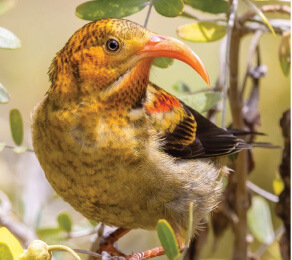
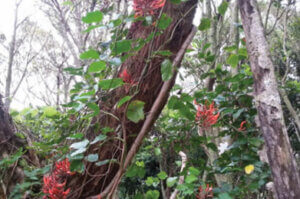
Nuku ʻiʻiwi, in the Pea Family, is an endemic tree-climbing vine in wettish forests, and its name refers to the bill of the ʻiʻiwi, to which its pua bear a strong resemblance. The plant is rare, but can still be found in appropriate forests on Kauaʻi, Oʻahu, Molokaʻi, Maui, and Hawaiʻi. Its seeds, about an inch long, recall those of what we used to call “sheep eye,” and apparently were used in lei.
Many are familiar with the blue or orange jade vines, close cousins of this mea lāʻau makamae. But please, let’s call ours “nuku ʻiʻiwi” rather than “Hawaiian jade.” Please? And go take a hike!