
By the Kaliʻuokapaʻakai Collective and Huliauapaʻa
Wahi kūpuna are Hawaiian ancestral places and resources, practices, and the knowledge systems inherently tied to them. They encompass the sacred sites where kūpuna rest, the living practices and protocols that sustain connection to them, and the moʻolelo that still speak to us across generations.
From 2025 through summer 2026, the Kaliʻuokapaʻakai Collective and Huliauapaʻa worked with Ward Research, Inc., to conduct a survey and generate a data-driven characterization of the Wahi Kūpuna Sector in Hawaiʻi.
For the purposes of the project, the “Wahi Kūpuna Sector” is defined as individuals and organizations across a variety of fields and disciplines who are involved in and/or impact the stewardship and protection of wahi kūpuna.
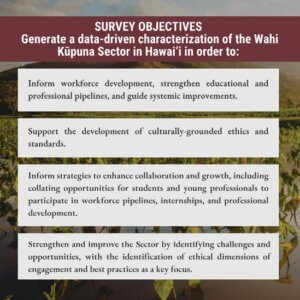
The first of its kind in Hawaiʻi, this project focused on gathering information and perspectives from stakeholders across a variety of disciplines and professions, and formal results reporting (Figure 1).
Project results indicate the sector is growing nationally, but that local data is severely lacking. National Cultural Resource Management expenditures are expected to reach $1.85 billion by 2031. Local sector data is piecemeal and incomplete, making it hard to understand the state of the sector in Hawaiʻi.
The workforce is dedicated yet financially precarious: 44% work multiple jobs, and 53% report they can save little or nothing for the future. Another 23% are considering leaving the field, with 69% of citing finances as the motivating factor. The sector runs on kuleana, and it is burning people out.
Survey Objectives
Generate a data-driven characterization of the Wahi Kūpuna Sector in Hawaiʻi in order to:
- Inform workforce development, strengthen educational and professional pipelines, and guide systemic improvements.
- Support the development of culturally-grounded ethics and standards.
- Inform strategies to enhance collaboration and growth, including collating opportunities for students and young professionals to participate in workforce pipelines, internships, and professional development.
- Strengthen and improve the Sector by identifying challenges and opportunities, with the identification of ethical dimensions of engagement and best practices as a key focus.
As the sector Hawaiian and community leadership, interview participants stressed cultivating the next generation of stewards through education, training, and mentorship to address underrepresentation, sustain the workforce, and fulfill responsibilities. Despite optimism, challenges persist, necessitating accessible entry points for ʻōpio (youth).
Participants encouraged young people to view the field as a cultural calling. Summer internships were praised for providing “transformational experiences,” though financial instability and limited job prospects remain persistent barriers.
Interview participants stressed that mentorship is vital for building job market confidence and overcoming educational challenges. Early participants recognized the need to “build that army” to address the field’s isolation in the 1990s. Others credited mentors for imparting valuable skills and inspiring them to pursue anthropology or create wahi kūpuna organizations. They agreed that effective mentors or experienced loea (experts) are crucial for success in the field.
Mentorship and early exposure are our most powerful pipeline tools. Some 89% developed their most valuable skills on the job, not in the classroom. Only 55% felt their academic preparation was adequate. Participants are calling for internships, mentorship programs, and high school-level exposure opportunities.
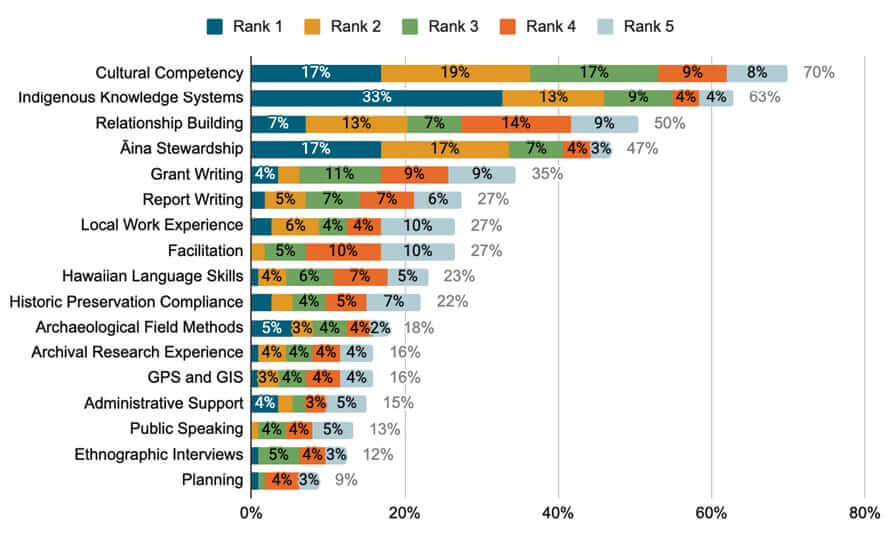
In-Demand Skills Chart – Long Description
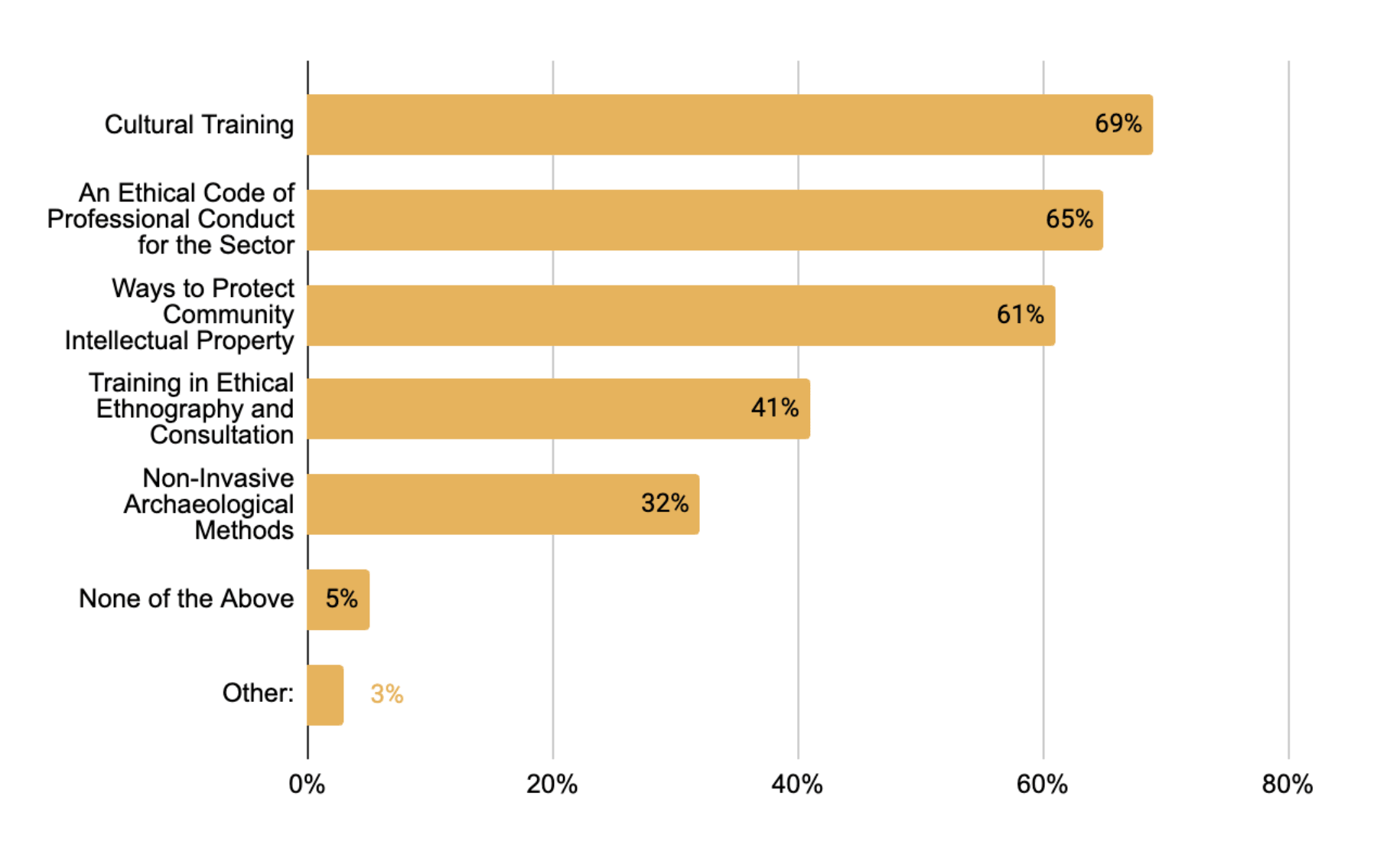
The sector is grounded in values and practitioners want that grounding formalized. Cultural competency, ʻōlelo Hawaiʻi proficiency, and understanding of Hawaiian knowledge systems ranked as the most in-demand skills (Figure 2) with 74% rating Hawaiian knowledge systems as “very important” within their organizations. A sector-wide consensus of 80% say ethics training is needed (Figure 3).
Collaboration and community engagement are strengths, with room for improvement. Some 86% of participants engage with community at least monthly and 74% involve communities in over half their projects. Yet only 54% feel that collaboration has been effective, indicating a need for more intentional, values-aligned partnerships.
The sector is optimistic and hopeful for the future. Despite challenges, practitioners see a genuine path forward through land trusts, new funding sources, Hawaiian-led institutions, and a rising generation with more support than those before them.
Mahalo nui to Kamehameha Schools (KS) for its funding support and to our partners, the Office of Native Hawaiian Relations; UH Mānoa Kamakakūokalani Center for Hawaiian Studies; UH Hilo Anthropology Department; Office of Hawaiian Affairs; Department of Hawaiian Homelands; KS ʻĀina ʻUlu; Historic Hawaiʻi Foundation; and Ward Research.
Access the Wahi Kūpuna Sector Survey Report at huliauapaa.org/wksector and follow us @huliauapaa and @kaliuokapaakaicollective. To attend the formal launch of the survey on November 17, register at: www.tinyurl.com/wksector.