
By Hannah Kihalani Springer and Kara Dumaguin
For generations, communities across Hawaiʻi have cared for the places they know best. They have watched changes in the land and water, understood when to gather resources and when they needed rest, and passed ʻike from one generation to the next.
That kind of stewardship existed long before there was a legal structure for co-management. The practice is not new. What is changing is the law around it.
This year, Hawaiʻi took an important step toward formally recognizing that work. In July, Act 203 was signed into law, giving the Department of Land and Natural Resources clearer authority to enter into formal co-management agreements with qualified community groups. The law also allows for the disposition of public lands through those agreements, creating another way for communities and the state to work together.

But the significance of Act 203 goes beyond the agreements themselves. It creates an opportunity to reconsider the relationship between community, government, and place.
For a long time, community engagement has largely been understood through participation in government processes: attending public meetings, submitting testimony, responding to proposed rules, raising concerns, and advocating for places and issues that matter.
Those forms of participation remain important. Co-management, however, invites a broader conversation.
Instead of asking only, “How can community participate in the state’s process?” another question becomes possible: What does it look like when community is not simply asked for input, but has real weight in how decisions about place are shaped?
That can mean staying engaged over time, sharing ʻike, working through differences, and remaining connected to what happens after a decision is made.
That greater role carries kuleana. But greater weight for community does not mean a smaller role for the state. Government agencies hold legal authority and regulatory obligations that communities do not. They also bring public resources, technical expertise, enforcement mechanisms, and systems that support the work.
Community brings relationships, lived experience, and ʻike rooted in place. Sustained connection can reveal patterns through observing change, caring for resources, and carrying knowledge across generations. Some patterns only become visible through years, sometimes generations, of paying attention.
Place-based ʻike does not replace the science, technical expertise, or regulatory knowledge government brings. It contributes to a fuller understanding of what is happening in a place and what that place may need.
Neither replaces the other. The state brings its kuleana. Community brings its own. Co-management creates space for those different contributions and ways of knowing to shape the work. It also raises a question for the state: What does it mean for government to truly show up in this relationship?
The question is not only whether community has a seat at the table, but what is valued once everyone gets there. If place-based ʻike is invited into the conversation, is it treated as another piece of public input or as knowledge that can help shape how a problem is understood and what happens next?
Co-management will look different across communities and places. Differences will arise in how a problem is understood, what a place needs, or who has authority to make a particular decision.
This is where pilina matters. Trust cannot be legislated, and relationships cannot be written into existence simply by putting names on a document. What matters is having relationships strong enough to navigate differences without abandoning the work.
Act 203 does not invent community stewardship. What it can do is create another structure for community and the state to meet differently.
For community, that may mean engagement that is more sustained rather than simply being consulted or providing testimony. Having a voice matters, but so does having that voice carry weight in what follows.
For the state, questions remain about how early community is brought into the conversation, how place-based ʻike is treated once shared, and what resources and support are brought to the relationship.
Legislation alone cannot answer these questions. Practice, relationships, and time will.
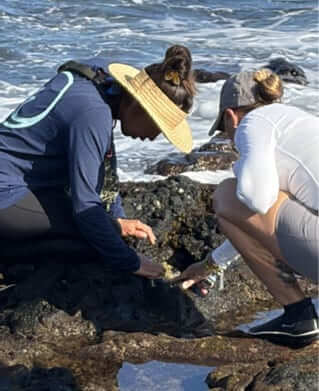
At Kaʻūpūlehu, Hui Kahuwai is already navigating many of these questions through its fisheries management and implementation work with the state. That experience offers an opportunity to look beyond what co-management can mean on paper to what it asks of community and government in practice.
Hannah Kihalani Springer is a kamaʻāina of Kaʻūpūlehu who has held a variety of volunteer, elected, and appointed positions in Hawaiʻi Nei. A child of active Hawaiian Civic Club members and a steadfast advocate of civic engagement, she and her family garden and raise livestock and native dryland forest plants at their ʻāina aloha, Kukuiʻohiwai, at Kaʻūpūlehu ma uka.
Kara Dumaguin is program director for Hui Kahuwai and has been part of the hui’s work at Kaʻūpūlehu for many years. Her work is grounded in pilina, kuleana, and a commitment to mālama the relationships between people and place.